

Running Forex EAs in prop firms has become riskier over the last few years. In 2026, most prop firms still advertise “EAs allowed,” but many quietly restrict the exact behaviors real automated systems rely on. Traders pass challenges, scale accounts, and then fail payouts because of technical violations they did not realize were enforced by the prop firm.
The issue is rarely automation itself. It usually comes down to how prop firm rules are written and how EAs actually behave in live execution. Latency handling, order modification frequency, stop loss visibility, trade duplication, and execution patterns matter far more than whether an EA is technically enabled inside a prop firm environment.
This gap has widened as prop firms have tightened enforcement. Detection systems have improved, and rules that were loosely interpreted in the past are now actively monitored by prop firms. Traders relying on old assumptions about EA friendliness are often the first ones surprised by violations during prop firm evaluations or funded phases.
This guide exists because of that shift. Instead of listing generic “best prop firms,” it breaks prop firms down by EA type, platform compatibility, and published enforcement rules. You will see which prop firms work for full automation, which prop firms only tolerate trade managers, and where platform limitations quietly override EA permissions inside a prop firm setup.
The goal is to make those constraints visible before they cost you a prop firm account. The shortlist, checklists, and policy breakdowns that follow are built around how EAs actually operate within prop firm rules, not how prop firm marketing pages describe them.
That distinction becomes obvious once you start filtering prop firms by EA behavior instead of reputation.
Quick shortlist (choose based on your EA type)
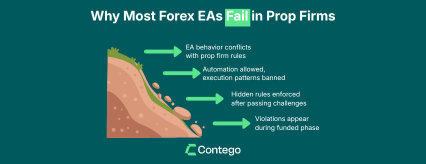
Before comparing prop firms, the most important decision is understanding what kind of EA you actually run. Many traders fail prop firm rules because they pick a prop firm first and only later discover that their EA behavior does not match the allowed practices.
This shortlist is structured as a decision filter. You start with how your EA behaves, then narrow down which prop firms realistically fit. This avoids the common mistake of choosing a prop firm based on reputation or price, only to violate a technical rule weeks later.
If you run full automation (EA opens and closes trades)
Full automation means the EA controls entries, exits, position sizing, and trade management without manual intervention. This is the most sensitive category because prop firms monitor execution patterns closely.
Prop firms that are commonly compatible with full automation include:
FTMO
Allows EAs, but strictly enforces forbidden practices. The biggest risks are EA hyperactivity, server request limits, and third party strategy duplication. Full automation works best when the EA uses realistic execution logic and avoids per tick modifications.
The5ers
Allows EAs with clear restrictions. Tick scalping, latency arbitrage, and stealth stop losses are not allowed. Stop losses must be visible on the server. Full automation can work, but only when the EA behavior is conservative and rule aware.
FunderPro
Allows EAs across multiple platforms but requires EA ownership. Exploiting execution gaps, latency differences, or platform inconsistencies is prohibited. Suitable for traders running proprietary EAs with stable logic.
Alpha Capital Group
Supports MT5 EAs and explicitly allows hidden stop losses. Pre approval or EA submission may be required. High frequency and latency based strategies are restricted, so automation must focus on structured execution rather than speed.
BrightFunded
Allows EAs, but enforcement details require careful review. Full automation is possible when the EA respects general execution limits and avoids arbitrage style behavior.
These prop firms work best for full automation when the EA is designed for compliance first, not execution edge exploitation.
If you only use a trade manager (SL, TP, BE, partial close)
Trade manager EAs do not open trades. They only manage risk and exits after manual entry. Most prop firms are far more tolerant of this setup because it does not affect entry execution or price discovery.
FundingPips
Explicitly allows third party EAs used strictly as trade or risk managers. Full automation is not allowed, but SL, TP, break even, and partial close managers are permitted when they do not interfere with execution logic.
Many prop firms that allow full automation also allow trade managers, but FundingPips stands out because the distinction is clearly stated in their rules. This makes it a safer choice for traders who manually enter but want automation for risk control.
If you need cTrader automation
Platform choice matters as much as the prop firm itself. cTrader automation is treated differently than MT4 or MT5 automation by many prop firms.
FundedNext
Allows EAs on MT4 and MT5, but does not allow automated trading on cTrader. This is a common failure point for traders who assume platform rules are identical. If your EA relies on cTrader automation, FundedNext is not a fit for that setup.
Prop firms that explicitly support automation on your chosen platform should always be confirmed through help center documentation before committing. Platform limitations often override general EA permissions.
Once you narrow prop firms by EA type and platform, the next step is understanding what “EA friendly” actually means in practice. That definition varies more than most traders expect.
What “EA-friendly” actually means
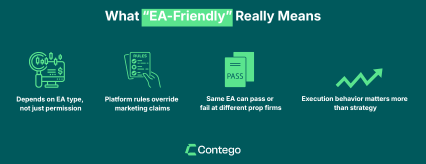
Many prop firms label themselves as EA friendly, but that label hides a lot of nuance. In practice, EA friendliness is not a yes or no question. It depends on how the EA behaves, which platform it runs on, and how the prop firm defines acceptable execution.
Two traders can both use EAs and have completely different outcomes at the same prop firm. One passes and scales. The other fails due to a technical violation. The difference is usually not the strategy logic, but how the EA interacts with the prop firm’s infrastructure.
Understanding what EA friendly actually means requires breaking automation into categories and then mapping those categories to platform rules.
The four EA categories prop firms care about
Prop firms do not evaluate EAs as a single group. Internally, most rules are written around behavior patterns. These are the four categories that matter in enforcement.
Full automation EA
This EA opens and closes trades, manages risk, and controls position sizing without manual input. This category receives the highest scrutiny because it directly affects execution patterns, server load, and pricing behavior. Most prop firm violations related to EAs come from this category.
Trade or risk manager EA
This EA does not open trades. It only manages stop loss, take profit, break even, trailing logic, or partial closes after a manual entry. Prop firms are generally more tolerant of this category because it does not influence entry execution or market interaction.
Copier or mirroring EA
This EA copies trades between accounts or mirrors another strategy. Many prop firms restrict or monitor this behavior closely because it can lead to group trading, duplicated execution, or capital allocation issues. This category often triggers violations even when the strategy itself is simple.
Hybrid or semi automated EA
This setup mixes manual decision making with automated execution or management. These EAs can fall into either allowed or restricted categories depending on how much control the automation has. Prop firms often evaluate these on behavior rather than labels.
Most traders assume that if a prop firm allows EAs, all four categories are acceptable. In reality, prop firms usually tolerate some categories while restricting others.
Platforms matter more than the prop firm name
The platform your EA runs on often matters more than the prop firm brand itself. Many prop firms apply different rules depending on whether the EA runs on MT4, MT5, cTrader, or a proprietary platform.
MT4 and MT5 have the largest EA ecosystems and the most clearly defined enforcement patterns. Most prop firm rules around EA behavior are written with these platforms in mind.
cTrader automation is treated differently. Some prop firms allow EAs on MT4 and MT5 but block automation on cTrader entirely. FundedNext is a common example where cTrader automation is not permitted even though MT4 and MT5 automation is allowed.
Web based or proprietary platforms introduce even more limitations. Automation support may be partial, restricted, or disabled entirely. In these environments, EA permissions on paper often do not reflect what is technically possible.
This is why EA compatibility must be evaluated as a combination of prop firm rules and platform capabilities. Ignoring either side leads to avoidable failures.
Once this foundation is clear, the next step is understanding which specific rules cause most EA disqualifications and how prop firms detect them in practice.
The rules that kill most EAs (and how prop firms detect them)
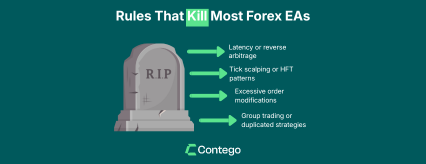
Most EA failures inside a prop firm do not come from bad strategy logic. They come from rule violations triggered by how the EA behaves at a technical level. These rules exist to protect the prop firm from execution abuse, infrastructure strain, and duplicated risk. Understanding them early prevents avoidable disqualifications.
Each rule below follows the same pattern: what the rule targets, why prop firms enforce it, and how traders usually trip over it.
Latency arbitrage, reverse arbitrage, and hedge arbitrage
Latency based EAs attempt to exploit price differences between feeds, execution delays, or broker response times. Reverse arbitrage often uses delayed execution to capture price corrections. Hedge arbitrage uses opposing positions across accounts or platforms.
Prop firms ban this behavior because it targets infrastructure weaknesses rather than market inefficiency. It creates unmanageable risk and exposes pricing systems to abuse. Many prop firms, including The5ers, explicitly list these behaviors as prohibited.
Detection usually comes from execution analysis. Prop firms compare entry timing, slippage patterns, fill consistency, and trade duration across accounts. Repeated edge capture around news or micro price discrepancies raises flags quickly.
How traders avoid this issue usually comes down to design choices. EAs should assume realistic slippage, avoid multi feed logic, and operate on timeframes where execution noise does not define profitability. Prop firms expect EAs to trade markets, not infrastructure.
Tick scalping and HFT style patterns
Tick scalping focuses on capturing very small price movements over extremely short durations. High frequency patterns generate a large number of orders and modifications in a short time window.
Prop firms restrict this behavior because it creates server load and execution risk that does not scale. The5ers explicitly bans tick scalping and HFT through EAs. Alpha Capital Group also restricts high frequency execution patterns tied to latency behavior.
Detection relies on trade frequency, order modification rates, and average trade duration. EAs that open and close dozens or hundreds of trades in minutes stand out immediately.
Avoiding this violation requires slowing the EA down. Increasing minimum holding time, reducing trade frequency, and focusing on higher timeframe logic keeps behavior within acceptable limits for most prop firms.
Hyperactive order modification loops
Some EAs modify stop losses or take profits on every tick. This creates constant server requests, even when price movement is minimal.
Prop firms like FTMO explicitly warn against EA hyperactivity and server request abuse. The issue is not trailing stops themselves, but how aggressively they update.
Detection focuses on the number of order modifications relative to market movement. An EA that sends thousands of modify requests during a quiet session triggers alerts.
Traders avoid this by throttling trailing logic. Modifying stops on candle close, distance thresholds, or timed intervals instead of per tick keeps behavior compliant.
Stop loss visibility rules
Stop loss handling varies widely across prop firms. Some prop firms require visible stop losses placed on the server. Others allow hidden or virtual stop losses managed internally by the EA.
The5ers requires stop losses to be visible. Stealth or virtual stops violate their rules. Alpha Capital Group allows hidden stop losses under their EA guidelines.
Detection is simple. Prop firms check whether a stop loss exists server side at trade entry. If none is present where required, the violation is immediate.
Avoiding this issue starts with reading the prop firm rule closely and configuring the EA accordingly. Many failures happen because traders assume all prop firms treat stop losses the same way.
Third party EA duplication and group trading
Group trading occurs when multiple accounts place identical trades using the same EA, parameters, and timing. This often happens unintentionally when traders buy popular third party EAs or copy configurations across accounts.
Prop firms restrict this behavior because it concentrates risk and undermines capital allocation models. FTMO warns that third party EAs can trigger strategy duplication flags. Alpha Capital Group explicitly enforces no group trading rules.
Detection compares trade timing, symbols, lot sizes, and execution patterns across accounts. Identical behavior across multiple prop firm accounts raises immediate concern.
Avoidance requires uniqueness. Traders should adjust parameters, vary symbols or timeframes, and avoid deploying the same EA setup across multiple accounts. Copy paste automation is one of the fastest ways to fail a prop firm evaluation.
Once these rule patterns are understood, the next step is checking EA compatibility before committing capital. That is where a structured checklist becomes essential.
EA compatibility checklist
Before running any EA on a prop firm account, it helps to slow down and verify compatibility systematically. Most EA failures happen because traders assume rules are flexible or identical across prop firms. A checklist removes that assumption and turns it into a controlled decision.
This checklist is designed to be used before you purchase a challenge or deploy an EA. If any item is unclear, that uncertainty alone is a warning sign.
EA type
Confirm whether the EA is full automation, trade manager only, copier, or hybrid. Prop firms treat these categories differently, even when all are labeled as “EA allowed.”
Platform
Verify which platform the EA runs on and whether automation is supported on that platform. MT4 and MT5 rules often differ from cTrader or proprietary platforms within the same prop firm.
EA ownership or approval
Some prop firms require that you own the EA source or submit the EA for approval. Third party EAs may trigger duplication or group trading rules.
Stop loss requirements
Check whether the prop firm requires a visible server side stop loss or allows hidden or virtual stops. This single rule causes a high number of avoidable failures.
Banned behaviors
Confirm whether the prop firm restricts tick scalping, latency arbitrage, reverse arbitrage, hedge arbitrage, HFT patterns, or execution exploitation. Many EAs unintentionally fall into these categories.
Order modification limits
Look for rules related to EA hyperactivity or server request limits. Trailing logic that modifies stops too frequently can violate these limits.
Drawdown model
Understand whether the prop firm uses static or trailing drawdown and how daily loss limits are calculated. Some EA logic unintentionally breaches drawdown rules due to position sizing or exposure stacking.
Copy trading restrictions
Check whether copying between accounts is allowed and under what conditions. Identical trade behavior across accounts often violates no group trading rules.
Running through this checklist forces clarity. It also exposes gaps in rule understanding before those gaps become violations. Most traders who fail EA related rules skipped this step entirely.
The next layer is comparison. Once compatibility is clear, comparing prop firms side by side makes decision making faster and more objective.
Comparison matrix
Once EA compatibility is clear, comparing prop firms side by side removes guesswork. Reading individual rule pages in isolation makes everything feel acceptable. Putting policies next to each other shows where real differences exist.
The goal of this section is not ranking. It is risk visibility. A prop firm that looks attractive on price or reputation can still be a poor fit once EA rules are compared directly.
EA policy matrix
This table highlights how major prop firms handle automation across platforms and behaviors. Always verify against the prop firm help center before committing, as rules can change.
| Prop Firm | Full-Auto EA Allowed | Manager EA Allowed | MT4 / MT5 EA | cTrader EA | Hidden SL Allowed | Pre-Approval Required | Key Banned Behaviors | Best For |
|---|---|---|---|---|---|---|---|---|
| FTMO | Yes | Yes | Yes | Yes | No | No | Latency arbitrage, tick scalping, hyperactivity, group trading | Conservative full automation |
| The5ers | Yes | Yes | Yes | Limited | No | No | Tick scalping, latency arbitrage, stealth SL | Rule-aware automation |
| FundedNext | Yes (MT only) | Yes | Yes | No | Platform-dependent | No (uniqueness enforced) | Strategy duplication, platform exploitation | MT4/MT5 automation |
| FunderPro | Yes | Yes | Yes | Yes | Platform-dependent | Yes (ownership) | Latency abuse, execution exploitation | Proprietary EA owners |
| BrightFunded | Yes | Yes | Yes | Platform-dependent | Needs verification | No | Execution abuse (varies) | Verified automation setups |
| Alpha Capital Group | Yes | Yes | MT5 only | No | Yes | Sometimes | HFT, latency arbitrage, group trading | MT5 EAs with hidden SL |
| FundingPips | No | Yes | Yes | Platform-dependent | Limited | No | Third-party full automation | Manual trading + managers |
| FXIFY (Forex) | Yes | Yes | Yes | Platform-dependent | Program-dependent | No | Depends on program | EA traders who verify rules |
| FXIFY Futures | No | No | No | No | No | N/A | Automation not allowed | Not suitable for EAs |
Common EA violations
| Violation | What It Looks Like | Why Prop Firms Ban It | Safe Alternative |
|---|---|---|---|
| Latency arbitrage | Exploiting price feed delays | Infrastructure abuse | Realistic slippage assumptions |
| Tick scalping | Many ultra-short trades | Server load + unfair execution | Higher timeframe logic |
| Hyperactive EA | Constant order modifications | Server request abuse | Throttled trailing logic |
| Hidden SL (when banned) | No server-side SL | Risk control enforcement | Visible SL on entry |
| Group trading | Identical trades across accounts | Capital concentration risk | Parameter randomization |
| Third-party duplication | Popular EA used by many | Strategy clustering | Custom parameters |
Firm by firm EA policy breakdowns
This section zooms in on each prop firm using the same structure so you can spot mismatches quickly. These are not reviews. They are risk profiles based on EA behavior.
FTMO
Best for
Full automation EAs on MT4, MT5, or cTrader that trade conservatively.
EA policy
EAs are allowed, including full automation and trade managers. FTMO enforces strict rules around execution behavior, server load, and strategy duplication.
Biggest risk of failure
EA hyperactivity and third party EA duplication. Many traders fail due to excessive order modifications or running popular EAs with identical parameters.
How to stay compliant
Throttle trailing logic, avoid per tick stop updates, and use unique EA parameters. Assume realistic slippage and execution delays.
Who should avoid
Latency arbitrage EAs, tick scalpers, and plug and play third party bots.
The5ers
Best for
Full automation EAs that use visible stop losses and moderate execution speed.
EA policy
EAs are allowed on MT4 and MT5. Tick scalping, latency arbitrage, and stealth stop losses are explicitly prohibited. Stop losses must be visible at entry.
Biggest risk of failure
Using hidden or virtual stop losses. This rule is enforced strictly.
How to stay compliant
Place server side stop losses on every trade and avoid execution edge strategies.
Who should avoid
Stealth stop EAs, grid systems with no hard stop, and high frequency logic.
FundedNext
Best for
MT4 and MT5 full automation EAs with unique logic.
EA policy
EAs are allowed on MT4 and MT5. Automated trading is not allowed on cTrader. Strategy duplication across accounts is monitored.
Biggest risk of failure
Running automation on cTrader or deploying identical EA setups across accounts.
How to stay compliant
Use MT4 or MT5 only, vary EA parameters, and avoid copy trading behavior.
Who should avoid
cTrader based automation and copier style EAs.
FunderPro
Best for
Traders running proprietary EAs they fully own.
EA policy
EAs are allowed across supported platforms. Traders must own the EA. Exploiting execution gaps or latency is prohibited.
Biggest risk of failure
Using third party EAs without ownership or relying on execution edge logic.
How to stay compliant
Run proprietary logic, document ownership, and trade with realistic execution assumptions.
Who should avoid
Resold EAs and arbitrage focused systems.
BrightFunded
Best for
Full automation EAs that stay within general execution limits.
EA policy
EAs are allowed. Enforcement focuses on behavior rather than EA type. Specific limits should be confirmed before deployment.
Biggest risk of failure
Assuming leniency without verifying execution and modification limits.
How to stay compliant
Keep trade frequency reasonable and avoid aggressive order modification.
Who should avoid
High frequency or latency dependent EAs.
Alpha Capital Group
Best for
MT5 automation with hidden stop loss logic.
EA policy
MT5 EAs are allowed. Hidden stop losses are permitted. Pre approval or EA submission may be required. HFT, latency arbitrage, and group trading are prohibited.
Biggest risk of failure
Group trading and shared EA behavior across accounts.
How to stay compliant
Use unique configurations and avoid synchronized trading behavior.
Who should avoid
Copy trading EAs and HFT style automation.
FundingPips
Best for
Manual traders using trade or risk manager EAs.
EA policy
Full automation EAs are not allowed. Trade managers for SL, TP, break even, and partial close are permitted.
Biggest risk of failure
Using any EA that opens trades automatically.
How to stay compliant
Limit EA use strictly to post entry risk management.
Who should avoid
Full automation systems of any kind.
FXIFY Forex vs FXIFY Futures
FXIFY Forex
EAs are allowed under specific programs. Grid and martingale strategies may be permitted depending on the account type. Rules must be verified per program.
FXIFY Futures
Automation is not allowed. This is a separate offering and should not be confused with Forex accounts.
Biggest risk of failure
Assuming Forex and Futures rules are interchangeable.
This breakdown usually makes one thing clear. Most EA failures are not about profitability. They are about mismatches between EA behavior and prop firm enforcement.
How to set up your EA to survive prop firm rules
Most EA failures inside a prop firm happen before the strategy even has a chance to prove itself. The issue is rarely edge. It is configuration. Small technical choices in how an EA behaves can trigger rule violations even when the trading logic is sound.
This section focuses on configuration habits that reduce risk across most prop firms. These are not optimization tips. They are survival rules.
Compliance first EA settings
Start by limiting how aggressive the EA can be at a technical level. Many default settings are designed for personal broker accounts, not prop firm environments.
Throttle order modifications. Trailing stops and break even logic should not update on every tick. Modify stops based on candle close, distance thresholds, or timed intervals. This avoids server request abuse and hyperactivity flags.
Use realistic slippage and spread filters. EAs that assume perfect execution often show suspicious fill patterns. Adding tolerance for slippage and widening spread filters makes execution behavior look normal under prop firm monitoring.
Cap maximum trades per day and total exposure. Even profitable EAs can trigger risk controls when trade volume spikes. Hard limits protect against accidental rule breaches during volatile sessions.
Avoid identical trading behavior across accounts. If you run multiple prop firm accounts, vary parameters, symbols, or timeframes. Group trading violations are often triggered by unintentional synchronization.
These settings do not make the EA worse. They make it compatible with how prop firms expect automated trading to behave.
VPS stability and execution consistency
Prop firms care about consistency more than speed. A stable execution environment reduces suspicious patterns.
Use a reliable VPS close to the prop firm server region. This minimizes erratic latency spikes and reconnect events that can distort execution behavior.
Avoid frequent disconnects or platform restarts. Reconnect spam can create abnormal execution logs that raise questions during reviews.
Keep logs and version records. Journals, parameter files, and EA versions matter when disputes happen. Being able to explain behavior clearly can make the difference in edge cases.
Prop firms rarely disqualify traders for being conservative. They disqualify traders when behavior looks uncontrolled or exploitative. Configuration discipline removes that risk.
With the EA configured correctly, the final step is knowing how to use this information to make decisions before committing capital.
Final thoughts
Running Forex EAs inside a prop firm in 2026 is less about finding permission and more about avoiding mismatches. Most failures happen because traders assume that “EA allowed” means their specific automation behavior will pass unnoticed. In reality, prop firms enforce rules at the execution level, not at the label level.
The prop firms that work best for EAs are not necessarily the most popular ones. They are the ones whose platform, rule structure, and enforcement logic align with how the EA actually trades. This is why filtering by EA type and platform matters more than ranking prop firms by reputation or price.
Traders who succeed with automation inside a prop firm usually follow the same pattern. They identify their EA category, narrow prop firms based on documented rules, and test behavior with small samples before scaling. They treat rule compliance as part of strategy design, not as an afterthought.
If you are running EAs seriously, your edge comes from preparation. Understanding enforcement patterns, configuring EAs conservatively, and choosing prop firms that match your execution style removes most of the hidden risk. Profitability only matters after the account survives.
FAQ
Are Forex EAs allowed in prop firms?
Yes, many prop firms allow Forex EAs, but permission alone does not guarantee compatibility. Most prop firms restrict specific EA behaviors such as latency arbitrage, tick scalping, excessive order modification, or group trading. An EA can be technically allowed and still violate prop firm rules in practice.
What is the difference between a trade manager EA and a full automation EA?
A full automation EA opens and closes trades automatically. A trade manager EA only manages positions after manual entry, such as setting stop loss, take profit, break even, or partial closes. Most prop firms are far more tolerant of trade manager EAs than full automation EAs.
Why do prop firms ban latency arbitrage and tick scalping?
Prop firms ban these strategies because they exploit execution mechanics rather than market movement. Latency arbitrage and tick scalping create infrastructure risk and do not scale safely for the prop firm. Detection is usually based on execution timing, slippage patterns, and trade duration.
Do prop firms require visible stop losses?
Some prop firms require stop losses to be visible on the server at the time of entry. Others allow hidden or virtual stop losses managed by the EA. This rule varies by prop firm and is enforced strictly. Traders should always verify this before running automation.
Can I use hidden or virtual stop losses with an EA?
Hidden stop losses are allowed only by certain prop firms. For example, Alpha Capital Group allows them, while The5ers requires visible stop losses. Using hidden stops where they are not permitted leads to immediate violations.
Can I use third party EAs bought online?
Some prop firms allow third party EAs, but many monitor for strategy duplication and group trading. Running a popular EA with default parameters across multiple accounts often triggers violations. Unique configuration is critical.
Why do prop firms ban group trading or identical trades?
Group trading concentrates risk and undermines capital allocation models. Prop firms detect identical trades across accounts by comparing timing, symbols, lot sizes, and execution patterns. Even unintentional duplication can violate rules.
Which platforms are best for EA trading in prop firms?
MT4 and MT5 offer the most consistent automation support across prop firms. cTrader automation is more restricted and must be confirmed per prop firm. Proprietary or web based platforms often limit automation entirely.
What is trading server hyperactivity and how do I avoid it?
Trading server hyperactivity occurs when an EA sends too many order modifications or requests in a short period. Prop firms detect this through server logs. Throttling trailing stops and reducing per tick logic prevents this issue.