
The prop firm landscape in 2026 is completely different from what we saw a few years ago. After multiple prop firm shutdowns, payout issues, and increased regulatory attention, traders have become far more cautious. They read more, compare more, and depend on Google, Reddit, YouTube, and Discord to understand which prop firms they can trust. This shift changed the role of SEO in the industry. Ranking today is not about adding keywords to a homepage. It is about showing enough trust signals so that both Google and traders view your prop firm as credible.
Competition has also intensified. Between 2023 and 2025 a huge wave of new prop firms launched, many of them using the same templates, the same taglines, and the same generic visuals. Traders recognize these patterns instantly and Google does too. The difference between a real prop firm and a weak one often shows up in the clarity of the website. Prop firms that invest in transparency, clear content, and original positioning naturally perform better.
Search behavior confirms this shift. Traders are no longer searching broad keywords. They now type specific questions such as:
“is [prop firm] legit”, “prop firm payout proof”, “best prop firm for EAs”, “prop firm rules explained”, “which prop firm is safest”.
These searches come from a place of caution. Traders want to confirm safety, fairness, and legitimacy before they even think about starting a challenge. If your content does not answer these questions clearly and quickly, both Google and traders move on.
This guide is a personal breakdown of what actually works for prop firm SEO in 2026. It is not generic SEO advice. It is based on real market behavior, real content performance, and firsthand experience creating content for prop firms that want to stand out instead of becoming another copy of what already exists.
Why Most Prop Firms Fail at SEO in 2026
Most prop firms struggle with SEO in 2026 because they launch websites that look identical to every other prop firm in the market. Nothing about the content, structure, or messaging signals originality or trust. Traders feel this immediately and Google detects it through weak engagement signals, poor content depth, and shallow authority.
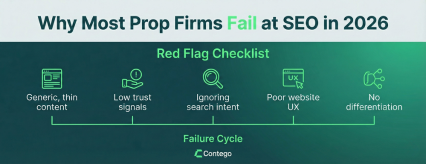
Generic and Thin Content That Answers Nothing
A large portion of prop firm websites use short, vague paragraphs that explain almost nothing about the rules, technology, payout reliability, or trading conditions. Google treats this as low value content. Traders feel the same way. When users land on a page and still do not understand how the prop firm works, they leave quickly. This creates weak dwell time, low retention, and poor ranking signals.
Lack of Trust and Transparency
Traders entering the prop firm space in 2026 want clarity. They look for payout proof, ownership information, support quality, rule breakdowns, and risk disclosures. Many prop firms hide these details or put them in confusing places. This instantly lowers trust. Google reacts to the same signals because pages with low clarity tend to generate poor engagement metrics.
Ignoring Long Tail Search Intent
Most prop firms try to rank for broad keywords like “prop firm” or “funded accounts,” but these keywords are dominated by the largest brands with years of authority. Meanwhile, traders are actually searching for very specific questions such as:
“is [prop firm] legit”
“best prop firm for EAs”
“prop firm payout proof”
Prop firms that ignore these long tail topics miss out on the easiest and most qualified traffic available.
Poor Website Structure and User Experience
Many prop firms use templates that are not built for real SEO performance. Slow load times, cluttered navigation, unclear rule pages, and missing internal links all hurt both user experience and search visibility. Traders leave when they cannot find answers quickly. Google interprets this as a sign that the content failed to meet search intent.
No Unique Positioning or Differentiation
Since most prop firms copy the same language and visuals, nothing signals to Google or traders that the business is unique. Without differentiation, no prop firm can build topical authority or brand trust. SEO requires depth, originality, and clear value, not recycled messaging.
In short, prop firms fail at SEO because they publish generic content, ignore search intent, and present themselves without clarity or transparency. The prop firms that succeed in 2026 are the ones that communicate clearly, answer real trader questions, and build a website that reflects trust instead of shortcuts.
What Prop Firm SEO Really Means in 2026
Prop firm SEO in 2026 is no longer about plugging a few keywords into your homepage and hoping Google picks them up. The landscape has shifted and the expectations from both traders and search engines are much higher. Google wants proof that the business is real. Traders want proof that the prop firm is trustworthy. The only way to meet both is through clarity, transparency, and consistent authority signals across the entire website.
SEO Is Now About Trust, Not Tricks
Search engines evaluate prop firms in the same category as financial services. This means Google applies higher scrutiny and expects stronger proof of legitimacy. Simple keyword targeting is not enough. Your prop firm must communicate ownership, rule transparency, payout reliability, and operational clarity before Google sees your site as valuable.
Long Tail Search Intent Dominates the Prop Trading Space
Traders rarely search broad terms anymore. They search with intention. Queries like “prop firm payout proof,” “is [prop firm] legit,” and “best prop firm for scalping” reflect a cautious audience that wants specifics. Prop firms that publish content targeting these questions outperform those that only chase broad keywords. Long tail intent is where real SEO leverage now exists.
Entity SEO Matters More Than Traditional Keyword SEO
Google ranks prop firms partly based on how clearly the website establishes itself as a real business. This is why transparent About pages, leadership details, payout structure pages, and rule explanations matter. These pages help Google build an entity profile for the prop firm. Without that profile, ranking becomes significantly harder.
User Experience Directly Affects Ranking
Traders do not tolerate slow, confusing websites. Prop firms that fail to optimize page load speed, navigation, and rule explanations see higher bounce rates. Google views these signals as proof that the page did not satisfy the user. Prop firms that invest in clean structure, fast pages, and direct answers rank higher because traders stay longer and engage more.
Content Depth Is the New Competitive Edge
The prop trading industry has matured. Search engines now expect deeper, more comprehensive content. Shallow pages are no longer rewarded. Prop firms that take the time to explain rules, break down risk models, educate traders, and offer actionable guidance build stronger topical authority and outperform competitors with thin content.
Prop firm SEO in 2026 is about trust, clarity, and value. Search engines reward prop firms that communicate openly, answer real trader questions, and present themselves like a company built to last. Those that continue with shortcuts remain invisible on the search results page.
The Trader Mindset Shift and Why SEO Must Match It
The biggest change in prop firm SEO does not come from Google. It comes from traders. Their behavior has evolved because the industry has gone through too many collapses, inconsistent payouts, unclear rules, and platforms that disappeared overnight. In 2026 traders carry a different set of expectations. They research more. They question more. They verify everything. Prop firm SEO must match this new mindset or the business will not earn trust.
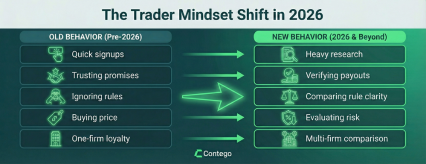
Traders Treat Every Prop Firm as High Risk Until Proven Otherwise
The old days when traders signed up simply because a prop firm offered high leverage or fast payouts are over. Today most traders assume a new prop firm could be unreliable until they see strong evidence. This is why they search for payout proof, audits, reviews, and clear rule explanations. A prop firm that does not answer these questions early loses the trader before any marketing begins.
Long Form Research Is Now Standard Before Buying
Traders used to compare prop firms based on the challenge price. Now they dive into Reddit threads, Discord groups, YouTube reviews, and comparison sites. They ask detailed questions like how the drawdown works, how strict the trading rules are, and whether previous payouts were successful. This long research cycle means your content must satisfy deeper intent, not just surface level information.
Search Behavior Reflects Skepticism
Search volume data shows that traders rarely search broad terms. Instead they look for clarity and reassurance. Popular searches include:
“is [prop firm] legit”
“prop firm payout success rate”
“prop firm rule breakdown”
“prop firm transparency review”
These are trust-driven searches. If your website does not address them clearly, Google sends users to prop firms that do.
Traders Expect Simple Language and Clear Explanations
Prop firms often write rules and guidelines in complex or vague language. This immediately lowers trust. Traders want clear, direct explanations written in plain English. Google rewards this style because it keeps users engaged. A confusing rules page is one of the biggest signals that a prop firm might not be reliable.
User Experience Shapes Perceived Legitimacy
A slow, cluttered, or outdated website creates doubt before traders even read the rules. When they see a modern, fast, and well-organized site, their risk perception drops. Google interprets higher engagement as a sign that the site is useful. Both impressions work together to improve SEO performance and conversion rates.
Traders today are more informed, more skeptical, and more selective. They look for prop firms that communicate clearly, show evidence of reliability, and respect the user’s time. The prop firms that understand this shift and align their SEO strategy with it will gain a strong advantage over those still relying on outdated tactics.
The Exact SEO Strategy I Recommend for Prop Firms in 2026
The most effective SEO strategy for prop firms in 2026 is built on a simple idea. Google rewards prop firms that behave like real companies and traders trust prop firms that communicate like real companies. Everything else builds on top of that. You can add keywords, backlinks, and technical optimizations, but none of it matters if the website does not show clarity, transparency, and long term intent.
The first priority is trust. Prop firms must present themselves in a way that leaves no confusion about how they operate. This means clear rule explanations, a transparent About page, visible payout information, and easy access to the details traders care about. Google uses these signals to understand that the business is legitimate, and traders use them to decide if they want to even consider a challenge.
Search intent is the second priority. In this industry most valuable searches come from long tail topics. Traders want specific answers such as how a drawdown works, which prop firm is safest for beginners, how a payouts structure compares, or what type of trader a prop firm is best for. Publishing content that targets these questions is the fastest way to build topical authority. Prop firms that do this consistently outrank competitors who only target broad, generic phrases.
Technical performance is the third pillar. A prop firm website must load quickly, feel clean on mobile, and make navigation effortless. Traders bounce instantly when a page loads slowly or when simple questions require too many clicks. Google sees this behavior and lowers rankings accordingly. A smooth experience improves both trust and search visibility.
Finally, the most successful prop firms create content that goes deeper than everyone else. They do not repeat what competitors say. They explain rules clearly, they educate traders, and they offer original insights that show they understand the market. This is how a new prop firm can compete with more established players. Depth and clarity build authority faster than hype ever will.
SEO in 2026 is not about tricks. It is a long term strategy built on trust, transparency, and real expertise. Prop firms that commit to this approach stand out immediately because most of the industry still relies on shortcuts.
What Prop Firm Websites Must Fix Immediately
Most prop firm websites fail before SEO even matters. The problem is not the keywords. It is the experience. Traders arrive with questions, concerns, and skepticism. When the website makes it difficult to find answers, the user leaves and Google lowers the ranking. The good news is that these issues are fixable, and improving them creates a noticeable lift in engagement, trust, and search visibility.
Rules That Feel Complicated or Hidden
Traders want clear rules. They want to know exactly how the drawdown works, how daily limits apply, how payouts are processed, and what the evaluation steps are. Many prop firms hide these details, spread them across several pages, or explain them in unclear language. Traders leave when they sense confusion. Search engines see the same behavior and conclude that the page did not satisfy the user intent.
Slow and Outdated Site Performance
A slow prop firm website signals low reliability. Most traders browse on mobile, and if the site loads poorly, they assume the business is not professionally run. Slow pages also create higher bounce rates, which weakens SEO. A fast, responsive site communicates stability and helps both rankings and conversions.
Generic Copy That Does Not Build Trust
Traders read the homepage and see the same phrases repeated across the industry. These lines no longer convince anyone because they lack real information. Prop firms need to replace generic copy with explanations that show transparency and long term intent. When traders feel the business is honest and well structured, they stay longer and start reading more pages.
Messy Navigation That Hides Important Information
Many prop firms bury the most important sections. Users should be able to find rules, payouts, pricing, and evaluations within seconds. Clear navigation is an SEO advantage because it increases user engagement and signals to Google that the site is well organized.
Weak or Missing Trust Signals
Traders look for payout examples, trader feedback, audit details, ownership information, and support responsiveness. When these signals are missing, trust drops immediately. A prop firm that displays its credibility clearly performs better across all marketing channels, including search.
Prop firms that fix these issues early gain a major advantage. They create stronger trust, higher retention, and better engagement. These signals help rankings grow naturally because the site keeps users on the page instead of pushing them away.
My Honest Opinion on Prop Firm Content
Most prop firm content today feels shallow. It tries to sound professional but ends up repeating the same lines traders have read a hundred times. When you look at the average prop firm website, you see vague promises, recycled descriptions, and rule pages that feel copied from competitors. None of this builds trust. It creates the opposite effect. Traders assume the prop firm is another short lived launch that spent more on a template than on clarity.
The real issue is that many prop firms write for themselves, not for traders. They choose impressive sounding words instead of explaining how things actually work. They focus on hype instead of guidance. Traders who already feel cautious immediately pick up on this mismatch. They leave because nothing feels original or helpful. A prop firm that truly wants to stand out must communicate with clarity and confidence. It must talk to traders in a direct and simple way.
I have seen enough prop firm websites to know that most collapses start with the content. When the rules are unclear, the payout structure is vague, or the language feels evasive, traders lose trust. Google picks up on the same signals. Pages with unclear writing, thin explanations, or confusing navigation tend to perform poorly in search. Prop firms that take shortcuts in communication rarely hold strong rankings or credibility for long.
Good content in this industry is not about sounding impressive. It is about being clear, transparent, and consistent. When a prop firm explains its rules properly, walks traders through the evaluation steps, and shares insights that help traders improve, it builds authority. This type of content keeps traders on the page longer and helps Google view the site as valuable. It also creates a perception that the business is stable and built to last.
Prop firms that put effort into their content gain an advantage that marketing money cannot buy. Clear communication builds trust. Trust builds conversions. And trust creates long term relevance that no shortcut can replicate.
How to Build a Prop Firm Blog That Actually Ranks in 2026
A prop firm blog cannot succeed with shallow topics or recycled industry content. Traders in 2026 expect depth. They expect real explanations, real guidance, and real insight into how prop firm trading works. Most of the industry still publishes weak promotional posts that add nothing to the search results. This is why a prop firm that invests in high quality educational content gains an immediate advantage.
The starting point is simple. Focus on the questions traders already search for. These are not broad or generic searches. They are specific queries that reveal real concern. When traders look for payout proof, rule explanations, or strategy advice, they want detailed answers that come from experience. A prop firm that answers these questions clearly builds trust with both users and Google.
A strong blog also avoids vague advice. Traders want actionable details such as how a specific rule affects a trading style or why a certain evaluation model works better for one type of trader than another. The deeper the content goes, the more credibility it creates. Thin or generic posts no longer perform because traders leave quickly and Google notices this pattern.
What Traders Want to Read
Traders want content that helps them make decisions. This includes how to pass a challenge, how different drawdown models work, the real differences between prop firms, and how payout policies compare. They also look for guidance that reflects the prop firm’s experience, not random trading quotes or motivational posts. Content must be practical, specific, and grounded in reality.
Why Depth Matters More Than Frequency
Publishing ten weak posts does not outperform one strong and detailed article. Google rewards depth because it keeps users engaged for longer periods of time. A well researched article that truly helps traders builds stronger SEO signals than a collection of short posts designed only to target keywords. Quality matters more than quantity, especially in a financial niche where trust is critical.
The Role of Consistency
A prop firm blog must be updated consistently. This shows both traders and search engines that the business is active and committed to sharing useful information. Consistency does not mean posting every day. It means keeping a steady cadence of content that reflects real trends in the prop trading space and helps traders make better decisions.
This is where many prop firms struggle. The ideas are there, but writing takes time, and maintaining quality while running a prop firm is difficult. This is exactly the gap a content subscription can solve. A service like Contego keeps the content flow stable so the prop firm continues to build trust and authority without trying to write everything internally. When the workload is handled by a dedicated team, consistency becomes easier and the SEO gains become long term.
A blog that focuses on depth, clarity, and consistent publishing becomes a real asset. It attracts long tail traffic, keeps traders engaged, and positions the prop firm as a reliable voice in a crowded market.
The Technical SEO Stack Every Prop Firm Should Use
Strong technical SEO is one of the easiest ways for a prop firm to get ahead of competitors. Most prop firms use the same templates, the same layout structures, and the same hosting setups, which often leaves major performance issues unresolved. A clean technical foundation gives Google confidence that the website is stable and well maintained. It also makes the user experience smoother, which keeps traders on the site longer.
One of the first priorities is page speed. Traders click away quickly when a site feels slow or unresponsive, especially on mobile. A prop firm should optimize images, remove unnecessary scripts, and use a hosting provider that can handle traffic spikes without lag. Fast loading pages reduce bounce rates and help build stronger ranking signals.
Structured data is another important element. It helps Google understand the different parts of the site, including rule pages, FAQs, contact information, payout explanations, and comparison tables. When this data is clear, the search engine can index the pages more accurately. This improves visibility and increases the chances of appearing in rich results.
Internal Linking and Site Structure
Internal linking is one of the most overlooked parts of prop firm SEO. A prop firm website should guide the user naturally from one page to another. For example, a rules page should link to payout information, and a blog about challenge strategies should link to the evaluation process. This helps Google map the website and understand the relationships between pages. It also improves user engagement because traders can find the answers they want without extra effort.
Mobile Optimization Is Not Optional
Most traders browse, research, and compare prop firms from their phones. A site that looks good on desktop but falls apart on mobile loses a major portion of its potential clients. Mobile optimization improves rankings because search engines track how well a site performs on smaller screens.
Security and Trust Signals
Technical SEO also includes basic trust elements. SSL certificates, safe browsing settings, clean code, and reliable hosting all contribute to how search engines view the site. Traders notice these details too. When a website feels secure, they stay longer and are more willing to explore sensitive sections such as payouts or pricing.
A strong technical foundation does not guarantee top rankings, but without it a prop firm will never reach its full SEO potential. Traders expect a smooth and reliable experience. Search engines expect a stable and well organized website. When both expectations are met, rankings improve naturally.
Data Backed Predictions About the Future of Prop Firm SEO Beyond 2026
The direction of prop firm SEO becomes clear when you look at the data that shaped the past few years. Search engines have raised their expectations for financial content, traders have become more selective, and search behavior has shifted toward detailed, trust focused queries. These patterns indicate how prop firm SEO will continue to evolve after 2026.
One of the strongest signals comes from Google’s stricter evaluation of financial related content. Prop firm websites fall under the YMYL category, which requires higher accuracy and stronger trust indicators. Google explains these standards in its official Search Quality Evaluator Guidelines. Pages that lack clarity or transparency perform poorly because both users and search engines require confidence before engaging with any financial offering.
Another important insight comes from Ahrefs, which found that more than 90 percent of all web pages receive no organic traffic. Their study on search performance is available here: Ahrefs Search Traffic Study. For prop firms, this means shallow, generic content will never rank. Only in depth and well structured content that answers real trader questions can break through intense competition.
Long tail keywords are also shaping the future of this niche. Tools like Semrush and Ahrefs show steady growth in searches such as “is [prop firm] legit,” “prop firm payout proof,” and “prop firm rules explained.” These searches reflect a cautious audience that wants clarity before investing in a challenge. Prop firms that build content around these queries gain stronger organic traction than those chasing broad terms with vague pages.
Technical performance continues to influence rankings as well. Backlinko’s breakdown of ranking factors highlights how page speed, clean structure, and mobile friendliness support stronger visibility. Their analysis can be found here: Google Ranking Factors. Traders often browse on mobile, so a slow or confusing site creates instant drop offs, which weakens SEO signals.
Global search behavior shows increasing interest in prop firms from regions like Eastern Europe, South Asia, and South America. This creates new opportunities for prop firms that simplify language or offer localized content. Sites that are easy for international traders to read consistently show stronger engagement.
Finally, community sentiment confirms a major shift. Discussions on Reddit, Trustpilot, Discord, and YouTube show traders becoming more skeptical after multiple prop firm closures between 2023 and 2025. They look for payout history, rule transparency, and operational clarity. These behaviors directly impact SEO because pages that answer difficult questions tend to keep users longer, which improves ranking strength.
When you combine these data points, the direction is obvious. Prop firms that invest in transparency, detailed content, and high quality user experience will continue to grow in visibility. Prop firms that rely on templates, hide rules, or publish thin content will not rank no matter what keywords they target.
The future of prop firm SEO belongs to businesses that communicate clearly, publish with intention, and earn trust through consistent, honest content.
Final Thoughts
Prop firm SEO is becoming a filter for credibility. When you look at the recent data, the search trends, and the long list of prop firms that collapsed after offering vague or incomplete information, the takeaway is simple. Search engines and traders now respond to the same signals. They reward clarity, transparency, and depth. They pull away from anything that feels rushed or uncertain.
The patterns in search behavior confirm this shift. Traders look for payout clarity, rule explanations, and detailed comparisons before signing up. Pages that provide this information hold attention longer and gain stronger ranking signals. Pages that avoid these questions lose visibility because users leave within seconds. Prop firms that build real content around real questions consistently outperform those that recycle the same thin descriptions the industry has used for years.
This is why the future of prop firm SEO belongs to teams that communicate like established financial businesses rather than temporary projects. Clear rule pages, in depth guides, transparent explanations of drawdown models, and long tail content that addresses real trader intent will decide which prop firms remain visible in the next few years. Shortcuts are no longer enough. Search engines have become more selective, and traders have become even more selective than that.
If your prop firm plans to compete seriously in 2026 and beyond, you need content that reflects that intent. You need writing that supports trust, improves engagement, and answers the questions traders actually ask. If maintaining this level of quality is difficult internally, Contego can handle the workload. Our content subscription provides the structure, consistency, and clarity that prop firm SEO now depends on.
The prop firms that invest in credibility will rise. The ones that avoid clear communication will quietly fade from the search results. The difference starts with the content you choose to publish.